
Free calculator
Check now
Vending cost check
Estimate the annual cost of your current workplace coffee, hydration and vending setup and see where savings may be possible.
A plumbed tap removes bottle orders, deliveries and storage. Getting people to use it is separate work, and it is the part that often gets skipped.
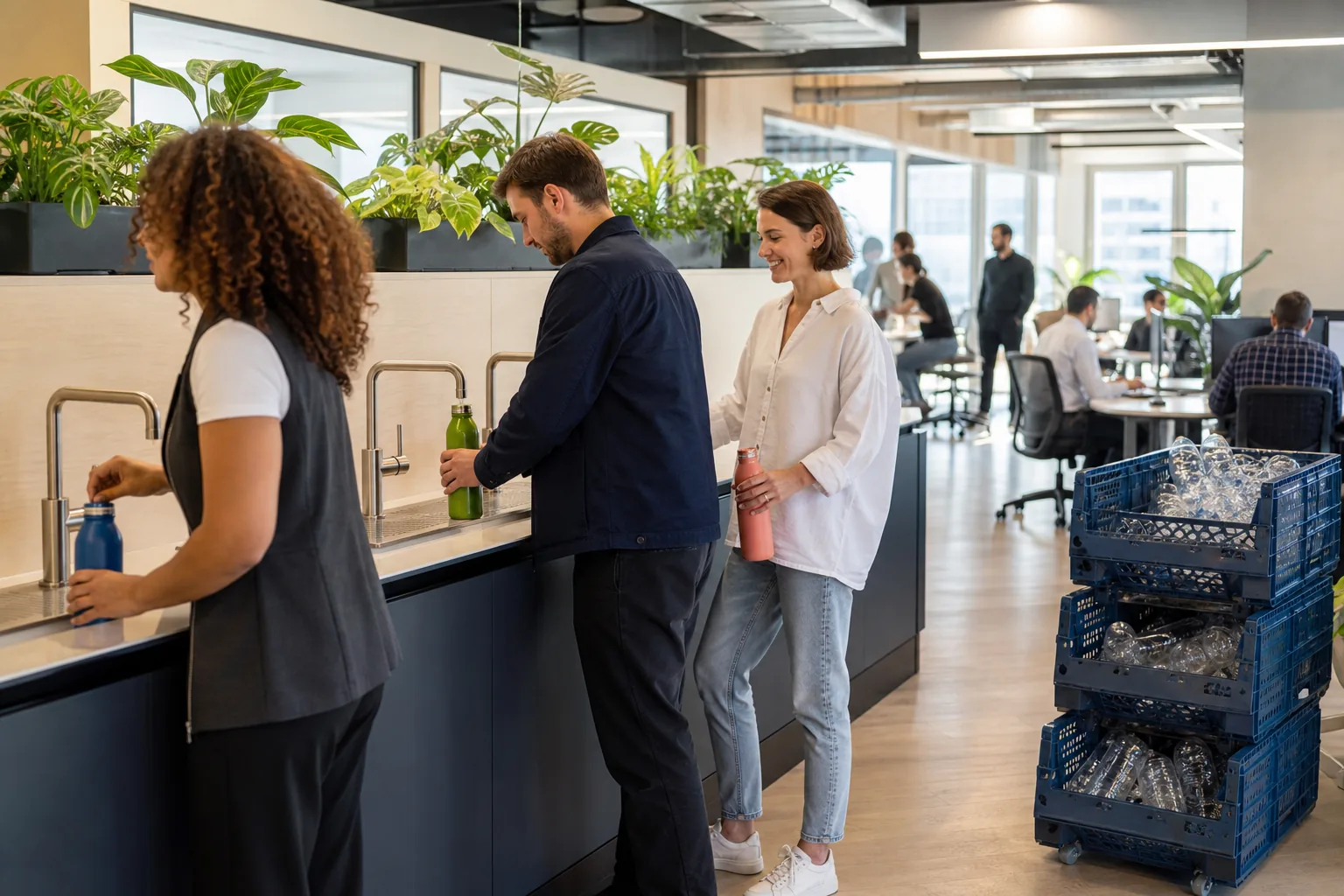
In short: Mains-fed hydration removes the bottle stream at source, no deliveries, no crates to store, no empties to dispose of. But equipment alone does not change behaviour. Sites that pair taps with reusable bottles, enough refill points and a visible switchover see the habit stick. Sites that install a tap and leave a pallet of plastic in the corner mostly do not.
Before changing anything, it is worth being precise about the sources, because they are not equally easy to address.
Bottled water coolers bring a recurring delivery of large bottles. Single-use bottles appear in meeting rooms, in fridges and at events. Cold drink vending contributes its own packaging. And in many buildings there is a quiet background stream of people buying bottled water off site and bringing it in.
Mains-fed hydration directly addresses the first two and influences the fourth. It does not remove vending packaging, and pretending otherwise makes the rest of your reporting less credible.
The clearest argument for a plumbed tap is not a percentage, it is that an entire stream stops existing. There are no bottles arriving, no crates to store, no empties to return or dispose of, and no delivery vehicle making the trip.
That also removes the associated handling. Nobody lifts a full bottle onto a cooler, nobody finds floor space for spares, and nobody manages a delivery schedule. The environmental case and the practical case point the same way, which is unusual and worth using when you make the internal argument.
Meeting rooms are the other significant win. Replacing bottled water on the table with jugs filled from a chilled tap removes a visible and surprisingly large volume of single-use plastic.
This is where most workplace plastic reduction programmes quietly fail. A tap gives people the option to refill. It does not give them anything to refill into, and it does not tell them the plastic has gone.
Sites that make it stick tend to do three things. They issue reusable bottles rather than suggesting people bring their own. They put glassware or jugs in meeting rooms so the default changes without anyone deciding. And they stop buying single-use bottles rather than running both in parallel.
That last one matters most. As long as there is a crate of plastic bottles in the corner, a meaningful proportion of people will keep taking one, because it is the path of least resistance.
Running a refill point and a stock of single-use bottles side by side is the most common way this fails. People take the easier option, and the tap gets blamed for low uptake it was never given a chance to achieve.
Distance decides uptake more than intention does. A tap two floors away will lose to a bottle in the nearest fridge nearly every time, regardless of how committed people say they are.
Map the routes people take during the day and put refill points on them, by the main staff kitchen, near the meeting rooms, on the way back from wherever people take a break. In warmer or more physical environments, put one close to the work rather than in the office area.
This is also a sizing question, and it is worth getting right for a specific reason: a queue at the refill point undoes the behaviour change you are trying to create. Systems are rated by users, and bottle-filling demand is heavier than tea-point demand, so size against the people who will actually use that point. Our guide to specifying a workplace water tap sets out the ratings.
A change nobody notices is a change nobody adopts. When the tap goes in, say so, what it is, why it is there, what is stopping, and what people should use instead.
It does not need a campaign. A short note when the equipment is installed, reusable bottles handed out on the same day, and the single-use stock removed rather than run down is usually enough to reset the default.
The moment of installation is the only moment where changing the habit is easy. After that you are asking people to break one.
A 300-person education site with bottled water in meeting rooms, a cooler in each staff area and cold drink vending in the main building.
The plan started with measurement rather than equipment: twelve months of purchase records pulled together first, so a defensible baseline existed before anything changed. Four refill points then went in on the routes people already walked, rather than in the positions that looked tidiest on a floor plan.
Reusable bottles were issued at induction rather than offered, jugs replaced bottled water in meeting rooms, and the remaining single-use stock was removed on installation day instead of being run down. Vending packaging was deliberately left outside the claim, because mains-fed hydration does not touch it.
future® Vending would always rather a site reported the bottles it can evidence from purchase records than a percentage nobody can trace back to a method. It is the more defensible number, and in an ESG report it is also the more useful one.
Be careful here, particularly if anything goes into public-facing material or an ESG report. Claims about environmental benefit are held to a high standard in the UK, and vague or unevidenced figures are a real risk rather than a theoretical one.
What you can say with confidence is factual and specific: that you have removed bottled water deliveries from a site, that meeting rooms no longer use single-use bottles, or that a given number of bottles are no longer being purchased, if you have the purchase records to show it.
What we would avoid is percentage reductions in plastic use that nobody has measured, or carbon figures that cannot be traced to a methodology. The factual version is more defensible and, in practice, more persuasive.
There are situations where bottled water remains sensible, and saying so makes the rest of your position more credible rather than less.
Short leases, temporary accommodation, buildings with no practical route for water and waste, and events all still point to bottled, we set those cases out in full in our comparison of filtered taps and bottled water. Business continuity belongs on the list too, where a stock of bottled water is a sensible contingency rather than a daily habit.
The goal is removing routine single-use plastic, not eliminating it in circumstances where nothing else works.
If this needs to appear in reporting, set the baseline before you install anything. Purchase records are the most defensible source, how many bottles and how much bottled water the site bought in the twelve months before the change.
After installation, the same records tell you what actually happened, and that is a figure you can stand behind. Waste collection data can support it where your facilities team captures it.
Measure the thing you control, state it plainly, and leave the estimates alone. It is a far stronger position than a headline percentage nobody can source.
Tell us about your people, peaks and space. We will recommend a practical starting point and explain the trade-offs clearly.
Request a free proposalShort answers to the points that come up most often when you are choosing equipment.
Speak to our teamIt removes the bottled water stream at source, no deliveries, crates or empties. Whether people stop using single-use bottles altogether depends on giving them reusable bottles and removing the plastic stock, not on the tap alone.
Issue reusable bottles rather than suggesting people bring their own, put jugs or glassware in meeting rooms, stop buying single-use bottles, and site the taps on routes people already walk.
Stick to what you can evidence, such as bottled water deliveries stopped or purchase volumes reduced against a documented baseline. Avoid unmeasured percentage claims or untraceable carbon figures.
Only for genuine cases such as business continuity, events or temporary sites. Running a refill point alongside a permanent stock of single-use bottles is the most common reason uptake stays low.
Set a baseline from purchase records for the twelve months before installation, then compare the same records afterwards. That is more defensible than estimated percentages.
Tell us what you are looking for and we will recommend the right coffee, water or vending setup for your site.
Estimate the annual cost of your current workplace coffee, hydration and vending setup and see where savings may be possible.
Estimate the cost of ending a current vending, coffee machine or refreshment agreement and review potential switch savings.