
Free calculator
Check now
Vending cost check
Estimate the annual cost of your current workplace coffee, hydration and vending setup and see where savings may be possible.
Choosing boiling, chilled or sparkling is the easy part. Whether the job runs smoothly depends on space, power and water under the counter.
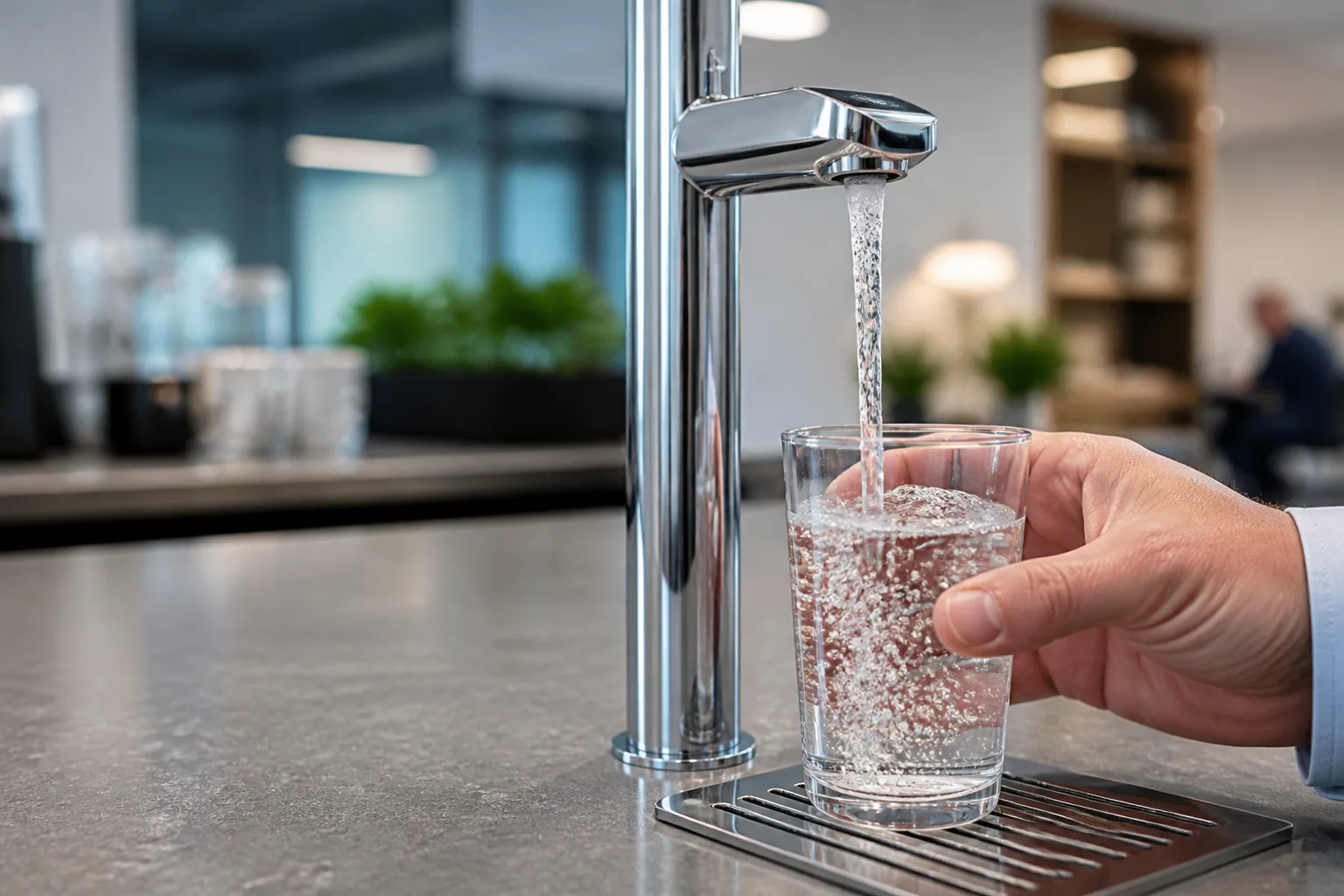
In short: Choose the water types first, then match the tap to how many people use that break area or sink, not the whole building, and check what fits in the cupboard under the counter. Boiling replaces the kettle, chilled replaces the bottled cooler, and sparkling suits reception or meeting rooms but needs a CO2 bottle stored below. How many people the unit is built to serve and the space under the counter matter more than the finish on the tap. Model names and brands appear from the next section onward.
Every other decision follows from this one, so settle it before looking at any specific model. Most workplace taps are configured for some combination of filtered boiling, filtered chilled and filtered sparkling, and some also provide unfiltered hot and cold water for washing up through the same fitting.
The temptation is to specify everything. Resist it slightly, each additional output adds cost, undercounter equipment and, in the case of sparkling, an ongoing consumable. Specify what the space actually needs.
Boiling is the output that does most to change how a staff kitchen works, because it removes the kettle. That means no waiting for a boil, no appliance taking up worktop, and no bottleneck at exactly the moment several people want tea.
Capacity is quoted in cups per hour. The Zip HydroTap G5 Classic Plus delivers 100 boiling cups per hour, and the Billi OmniOne Pro60 is rated at up to 180 boiling cups per hour under Billi test conditions.
If you only add one output beyond ambient water, this is the one that people notice immediately.
Chilled filtered water is what drives the reusable bottle habit and removes the need for a bottled cooler. It gets used steadily all day rather than in spikes, and it is the output most closely tied to whether people actually drink enough water at work.
The Zip HydroTap G5 Classic Plus provides 75 chilled cups per hour. The Billi OmniOne Pro60 is rated at up to 220 chilled or sparkling cups per hour. Where demand is heavier, such as a gym, a warm production environment or a large open floor, the Aqua Libra Alto is rated at up to 80 litres per hour.
Note the difference in units. Cups per hour suits staff kitchens; litres per hour is the more useful measure where people are filling large bottles.
Sparkling water is a genuine upgrade in client suites, meeting floors and reception areas, and it is popular wherever it is installed. The Zip Celsius Plus and Billi OmniOne Pro60 both offer it alongside boiling and chilled.
What it also adds is a CO2 cylinder. That needs space in the cupboard alongside the undercounter unit, and it needs replacing periodically, so it becomes part of your service arrangement rather than a one-off.
Our honest guidance is to specify sparkling where it will be seen and appreciated, and skip it in back-of-house kitchens where chilled would do the same job without the consumable.
Sparkling is the output most often specified on enthusiasm and then regretted on service cost. Put it where visitors are, not everywhere.
Some systems combine drinking water and general-purpose water in a single tap, which is useful where worktop space is tight or you would rather not have two fittings at one sink.
The Zip Celsius Plus All-in-One is the clearest example in our range, filtered boiling, chilled and sparkling drinking water plus unfiltered hot and cold mixer water for washing up, from one arc-style tap.
It is a neat solution for a single-sink kitchen. Where you already have a standard mixer tap that works, a dedicated drinking water tap alongside it is often simpler.
Manufacturers rate systems by users, and that rating is the most useful sizing number because it already assumes how often people come back.
In our range the Zip HydroTap G5 Classic Plus H55702Z01UK is configured for up to 20 users. The Zip Celsius Plus BCS60 is rated for up to 60 users, as is the Billi OmniOne Pro60, which Billi rates for up to 60 people.
The critical point is the denominator. A 200-person office with four kitchens is four separate sizing questions, not one. Treating it as a single 200-user problem leads directly to over-specifying, and to putting a large unit where a smaller one would have served better.
This is where installations succeed or stall. The tap is the visible part; the undercounter unit is the part that has to physically fit alongside whatever is already in that cupboard.
As a concrete example, the Billi OmniOne Pro60 undercounter unit measures 355mm high by 395mm wide by 495mm deep. It needs a 13A switched socket inside the cupboard and runs from a 15mm drinking water supply, and it requires no cupboard ventilation. Add a CO2 cylinder if sparkling is included.
Alongside that you need a waste route and enough clearance to get to the unit for filter changes and service. A cupboard that already holds a waste bin, a boiler and the building's stopcock is a tighter proposition than it looks on a plan, which is why we measure rather than assume.
A 140-person office with two very different drinking water points on the same floor: a main kitchen used by around 100 people, and a client suite used by perhaps 20.
They are two specifications, not one. The main kitchen takes a Billi OmniOne Pro60, rated for up to 60 people with up to 180 boiling and 220 chilled or sparkling cups per hour, sized against that kitchen rather than the building. The client suite takes a smaller unit, and it is the one place in the building where sparkling earns its CO2 cylinder.
The cupboard decided the rest. The OmniOne undercounter unit needs 355mm by 395mm by 495mm, a 13A switched socket and a 15mm supply, and the intended cupboard already held the building stopcock, so the tap moved 600mm along the run to the next one.
That last detail is the reason future® Vending measures the cupboard before quoting rather than after. It is a five-minute check that would otherwise have become a second visit.
Filtration is part of the specification, not an afterthought. Zip HydroTap systems use 0.2 micron MicroPurity filtration with SteriTouch hygiene features. The Billi OmniOne Pro60 is supplied with a five micron BWT Fibron X filter as standard.
Filters are consumables with a defined replacement interval based on the model and how much water passes through them. Build them into a care plan at the point of specification so replacement is scheduled rather than remembered, it is a far easier conversation before installation than after.
Tell us about your people, peaks and space. We will recommend a practical starting point and explain the trade-offs clearly.
Request a free proposalShort answers to the points that come up most often when you are choosing equipment.
Speak to our teamMost combine filtered boiling, chilled and sparkling drinking water. Some systems, such as the Zip Celsius Plus All-in-One, also supply unfiltered hot and cold mixer water for washing up through the same fitting.
It depends on the model. In our range the Zip HydroTap G5 Classic Plus is configured for up to 20 users, while the Zip Celsius Plus BCS60 and Billi OmniOne Pro60 are rated for up to 60. Size against that kitchen or break area, not the whole building.
Yes. Sparkling requires a CO2 cylinder in the cupboard alongside the undercounter unit, and it needs periodic replacement, so it becomes part of your ongoing service arrangement.
As an example, the Billi OmniOne Pro60 undercounter unit is 355mm high, 395mm wide and 495mm deep, needs a 13A socket and a 15mm supply, and requires no cupboard ventilation. You also need a waste route and access for filter changes.
Filters have a defined replacement interval set by the model and the volume of water passing through them. We build filter changes into a care plan so they are scheduled rather than reactive.
Tell us what you are looking for and we will recommend the right coffee, water or vending setup for your site.
Estimate the annual cost of your current workplace coffee, hydration and vending setup and see where savings may be possible.
Estimate the cost of ending a current vending, coffee machine or refreshment agreement and review potential switch savings.