
Free calculator
Check now
Vending cost check
Estimate the annual cost of your current workplace coffee, hydration and vending setup and see where savings may be possible.
A filtered tap cuts deliveries, lifting and plastic waste. Bottled coolers need no plumbing. Here is how to choose for your site.
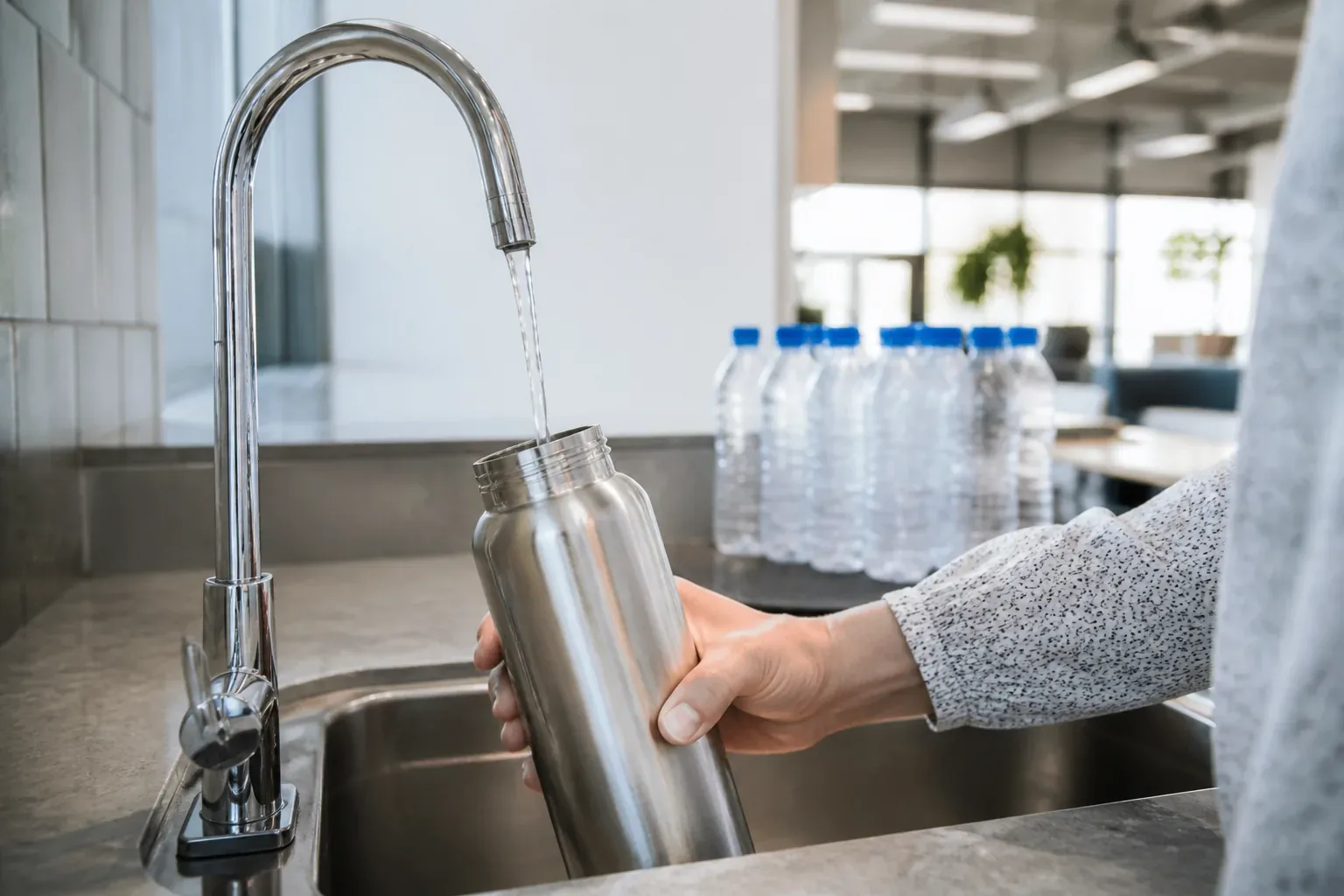
In short: A mains-fed filtered tap removes the ordering, storage, delivery and disposal that bottled water creates, and it does not run out mid-afternoon. Bottled water needs no plumbing, so it still suits short leases, temporary sites and locations with no practical water route. For a permanent workplace with a staff kitchen or break area, a plumbed tap is usually the better long-term answer, provided it is sized and sited properly.
Bottled water looks simple because the commitment is small. There is no installation, no plumbing and no capital decision. What there is instead is a recurring cycle: ordering, taking delivery, finding somewhere to store full bottles, lifting them onto the cooler, and dealing with the empties. On a busy site that quietly consumes somebody's time every week.
A mains-fed tap front-loads the effort instead. There is a site check, an installation involving water, power and waste, and a filter that needs changing on a schedule. After that, the ongoing burden is close to zero and the supply does not run out.
The trade is straightforward: bottled water is low commitment and permanently high effort; a plumbed tap is higher commitment and then largely invisible.
The two are measured in different currencies, which is what makes them awkward to compare directly. A cooler is rated by what is in the bottle: once that is gone, capacity is zero until somebody carries a new one over. A tap is rated per hour and by the number of users it is configured for, and it does not run out at all.
The difference shows at the same moment coffee machines struggle, the crush after a meeting ends, or the start of a shift. A cooler on a busy floor copes with steady use through the day and then empties visibly during a rush, at exactly the point nobody is free to change it.
When sizing, the rated user count is the figure to work from, because it already assumes how often people come back. The ratings across our range, and how to size against a specific kitchen or break area, are set out in our guide to specifying a workplace water tap.
A tenanted office building over three floors, with around 55 people on each and a bottled cooler on every floor.
The real cost was never the bottles. It was three separate delivery cycles to receive and sign for, floor space on every level given over to full and empty bottles, and a kettle still sitting on each worktop because the coolers only did cold.
A Zip Celsius Plus BCS60 on each floor, rated for up to 60 users, matched the population per floor rather than the building as a whole, and removed the deliveries, the storage and the kettles in a single move.
Multi-tenant buildings are where future® Vending sees the sharpest difference, because the space handed over to bottle storage is space the tenant is already paying rent on.
Bottled systems involve manual handling. Full bottles are heavy, they are usually stored at floor level, and the moment of changing one is the moment the system is most exposed. None of that is a reason to rule bottled water out, but it belongs in a risk assessment rather than being treated as a non-issue.
Plumbed taps move the hygiene question into filtration and dispense, which turns a weekly handling exercise into a scheduled one. Filters are consumables with a defined replacement interval, and that is a far easier thing to plan around than a delivery relationship. Which system uses which filtration is covered in our guide to specifying a workplace water tap.
Bottled coolers rarely replace the kettle, so most staff kitchens end up running both. A boiling tap does replace it, and that changes the dynamic of the space more than the water itself does.
Picture a 40-person floor with a single kettle. It boils for far longer than anyone needs, it creates a bottleneck exactly when several people want tea at once, and it takes up worktop that a small kitchen rarely has spare. A boiling and chilled tap removes the wait, the appliance and the worktop clutter in one move, which is often what actually sells the change internally.
The honest environmental claim here is a narrow one, and it is stronger for being narrow. Removing a bottled cooler removes a delivery, a storage requirement and a disposal route from that site, and each of those is something you can evidence from your own records rather than estimate.
What a tap will not do on its own is change habits, and it does not touch the packaging arriving through vending or in people's bags. How to make the switch actually land, and what you can safely put in a report, is covered in our guide to reducing single-use bottles.
There are genuine cases where bottled is the right call and we will say so. Short leases where you will not recover the installation. Temporary accommodation and site cabins. Locations where there is simply no practical route for water and waste, a mezzanine, a listed building, a leased floor where you cannot touch the services. Events and overflow demand that only exists for a few weeks.
Construction welfare units are the clearest example. The site moves, the water route changes, and portability matters more than running cost.
Specifying a tap is mostly about what sits under the counter rather than the tap itself. A typical undercounter unit wants roughly half a metre in each direction, a switched socket inside the cupboard and a 15mm drinking water supply, plus room alongside for a CO2 cylinder if sparkling is included, in a cupboard that often already holds a waste bin and the building stopcock. The exact dimensions vary by system.
We confirm supply, pressure and flow, waste route, power, cupboard space and the tap position before quoting, because those details decide whether the options are real or theoretical.
Tell us about your people, peaks and space. We will recommend a practical starting point and explain the trade-offs clearly.
Request a free proposalShort answers to the points that come up most often when you are choosing equipment.
Speak to our teamIt depends on volume and how long you stay. A tap carries an installation cost and filter changes but no deliveries; bottled water has no install cost but a permanent recurring spend. Higher-consumption sites on longer leases usually favour a tap.
Yes, provided it is rated for the number of people using that kitchen or break area. A tap refills continuously and is rated per hour, so unlike a bottled cooler it never sits empty waiting for someone to carry a new bottle over. The crush after a meeting ends is where the difference shows most clearly.
Yes. A mains-fed tap needs a drinking water supply, power and a waste route, plus undercounter space for the unit and any CO2 cylinder. This is exactly what a site check confirms before we quote.
Yes. Several systems in our range combine filtered boiling, chilled and sparkling from a single tap, which removes the kettle and a separate cooler at the same time.
No. A filter has a defined replacement interval set by the model and daily use, and it is handled on a planned visit rather than by your team. Bottled water asks something of somebody every week instead, ordering, receiving, storing and lifting.
Tell us what you are looking for and we will recommend the right coffee, water or vending setup for your site.
Estimate the annual cost of your current workplace coffee, hydration and vending setup and see where savings may be possible.
Estimate the cost of ending a current vending, coffee machine or refreshment agreement and review potential switch savings.