
Free calculator
Check now
Vending cost check
Estimate the annual cost of your current workplace coffee, hydration and vending setup and see where savings may be possible.
Most installation problems are avoided by the site check, and that is the step people are most tempted to skip.
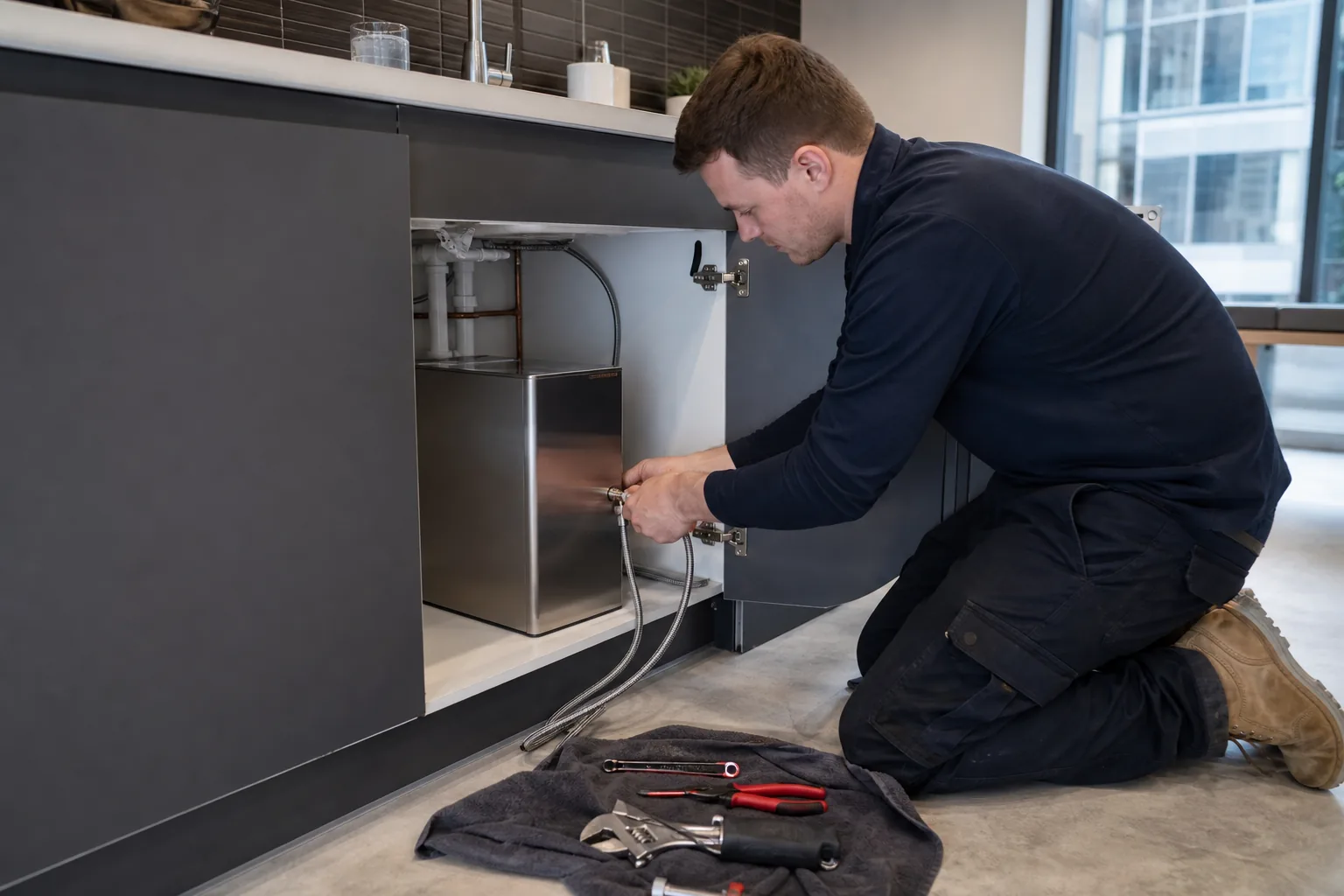
In short: There are six stages: a conversation about your people and peaks, a site check of utilities and access, a written recommendation, scheduling around your working day, installation, set-up and testing, then handover and training. The site check is the one that matters most, almost every installation problem traces back to something that was assumed rather than measured.
Before any equipment is discussed, the useful questions are about people. How many are on site on a busy day rather than on the payroll. When the peaks fall. Whether shifts run beyond office hours. What the current setup does badly, and what nobody wants to lose.
It is also where we establish who will look after the equipment day to day, because that single answer shapes the recommendation more than almost anything else, particularly the choice between bean-to-cup and instant, or between self-managed and managed vending.
This stage can be a phone call. It does not need a site visit, and it saves one if the answers rule out half the options.
This is the stage that decides whether the rest goes smoothly, and it is worth insisting on rather than accepting a quote generated from a floor plan.
For coffee machines we are checking worktop depth and clearance, power, whether the machine will run from a tank or needs a permanent water connection, drainage, and whether there is room to open the machine for servicing. For water taps it is the drinking water supply, pressure and flow, the waste route, a switched socket in the cupboard and the physical space under the counter, remembering that a sparkling system needs room for a CO2 cylinder as well.
For vending it is floor level and load, power within reach, ventilation clearance for chilled machines, and the delivery route: lift dimensions, door widths, thresholds and any ramps between the vehicle and the final position.
That last point catches more installations than any technical issue. A machine that fits perfectly in its intended spot is no use if it cannot get through the building to reach it.
If a supplier quotes for a plumbed installation without visiting, treat the price as provisional. Supply, waste and access are the three things that change quotes after the fact, and none of them can be confirmed from a plan.
An 80-person office on the second floor of a converted building, with a boiling and chilled tap planned for the main staff kitchen.
On paper the position was obvious, the far end of the run, where the worktop was clear and the tap would look right. The site check found no waste route within six metres of it. Reaching the nearest one meant chasing through a structural wall, which brings in a builder, a second visit and a cost nobody had budgeted for.
Moving the tap to the opposite side of the same kitchen put it within a metre of an existing waste connection. The installation went in on one visit, and the only thing lost was the position someone had first pictured.
This is the whole argument for stage two. future® Vending would far rather move a tap three metres on a drawing than discover the problem with an engineer already on site.
The proposal should tell you what is being recommended and why, in terms you can check against your own understanding of the site, the capacity it is rated for, how that maps to your peak, what it needs in utilities, and what the ongoing service and consumables involve.
Where a commercial route is open, buying, renting and leasing should be set out for the same machine so the comparison is like for like rather than steering you toward one.
Be wary of a proposal that leads with a machine and works backwards to a justification. The reasoning should follow from the numbers you gave in stage one.
Installations are disruptive in a small way, and the disruption is easy to manage if it is planned. A tap installation means water off for a period. A vending delivery means a clear route through the building. A coffee machine swap means the kitchen or break area is out of action for part of a day.
Most sites choose early morning, late afternoon or a quieter day of the week, and multi-floor work is often staged so no floor loses everything at once. If access is controlled, this is also the point to arrange passes, parking and any site induction.
Where an existing machine is being replaced, its removal is planned into the same visit so there is no gap and no redundant equipment left in a corridor.
Installation is the physical work: connecting supply and waste, positioning and levelling the machine, fitting the tap and undercounter unit, testing for leaks and confirming the electrical supply.
Set-up and testing is the part that gets overlooked and matters as much. The machine is set up for the drinks you will actually serve, covering grinder settings, drink strengths and volumes, milk configuration and temperature, then run through until the output is right. Filters are fitted and flushed, and water quality is checked.
A machine that is installed but not properly set up and tested works, but it does not work well. It is the difference between coffee that is technically produced and coffee people choose to drink.
Handover is where the people who use the equipment learn how to run it, the daily routine, how to start a cleaning cycle, how to refill beans, milk or ingredients, how to clear a common fault and when to call rather than investigate.
Train more than one person. The single most reliable predictor of a machine that deteriorates is that only one person was shown how to look after it, and they later moved on or went on leave.
You should also leave with the practical documentation: what the service schedule is, when filters are due, and the number to call when something stops.
The relationship after installation is mostly filters, servicing and support, and the useful thing to settle at handover is when each falls due and who starts it. What those visits involve, and what sits with you between them, is covered in our guide to cleaning and caring for a commercial coffee machine.
What belongs in this stage is the paperwork rather than the practice: a service schedule you actually hold a copy of, filter intervals recorded somewhere other than one person's memory, and a single number to call. Installations that go quiet after handover are usually the ones where none of that was written down.
For vending under a managed arrangement, this is also where replenishment visits and range reviews begin, and where the product mix should start adjusting to what actually sells.
Three things, in our experience, and none of them are equipment.
Access. Lifts, loading bays, door widths, parking and site inductions arranged too late.
Utilities. A water supply that is not where the plan showed, a cupboard with no socket, or a waste route that needs building work first.
Decisions. Sign-off waiting on someone who is on leave, or a change of mind about position after the survey.
All three are avoidable, and all three are why the site check exists.
Tell us about your people, peaks and space. We will recommend a practical starting point and explain the trade-offs clearly.
Request a free proposalShort answers to the points that come up most often when you are choosing equipment.
Speak to our teamA straightforward countertop installation, set-up and testing is usually a matter of hours rather than days. Plumbed installations and vending deliveries depend on the supply route and access, which the site check confirms in advance.
For anything plumbed, yes. Water supply, waste route and access are the three things that change quotes afterwards, and none of them can be reliably confirmed from a floor plan.
Only briefly, and it is planned around you. Most sites choose early morning, late afternoon or a quieter day, and multi-floor work is staged so no area loses everything at once.
Set-up and testing means tuning the machine for the drinks you will serve, covering grinder settings, strengths, volumes, milk configuration and temperature, then flushing the filters. An installed but untested machine works, but it does not produce coffee people enjoy.
More than one person. Machines deteriorate most reliably when only one person was trained and later moved on or went on leave.
Tell us what you are looking for and we will recommend the right coffee, water or vending setup for your site.
Estimate the annual cost of your current workplace coffee, hydration and vending setup and see where savings may be possible.
Estimate the cost of ending a current vending, coffee machine or refreshment agreement and review potential switch savings.