
Free calculator
Check now
Vending cost check
Estimate the annual cost of your current workplace coffee, hydration and vending setup and see where savings may be possible.
When workplace coffee goes downhill, the cause is usually cleaning and who owns it, not the machine brand on the front.
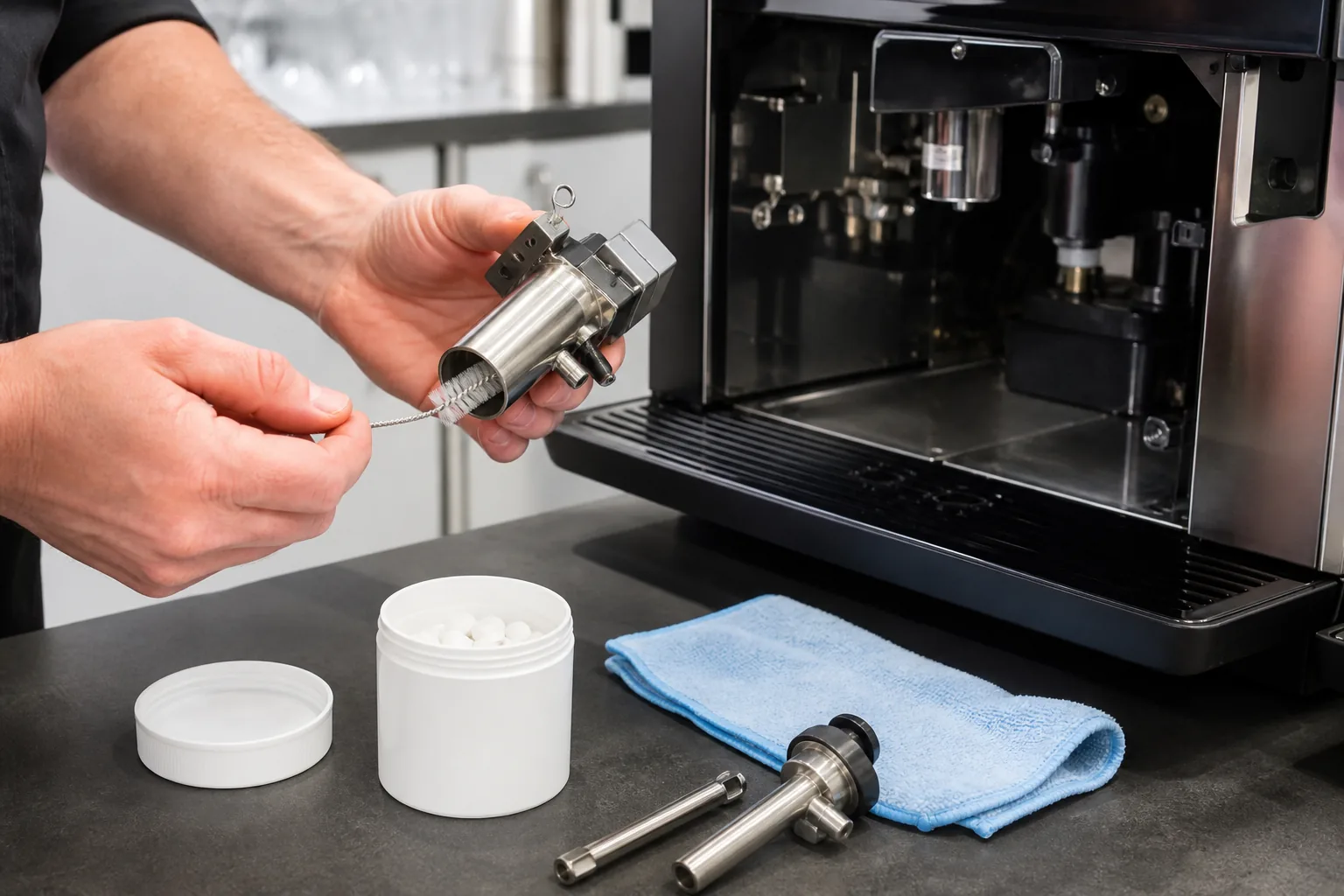
In short: Most modern workplace machines automate much of the cleaning when someone runs the prompted cycle and empties waste and milk parts. They cannot start on their own or take day-to-day ownership of the milk system. Decide who owns those tasks before you buy, because that affects drink quality more than choosing between two good models.
Automatic cleaning has changed workplace coffee substantially. WMF machines use Click+Clean or Plug+Clean depending on the model, and Franke offers EasyClean across much of its range. The machine tracks its own usage, prompts when a cycle is due, guides the operator through it and runs the cycle itself.
That covers the internal brewing path and, on machines with milk systems, a rinse and clean of the milk circuit. It is effective, and it removes most of the skill from the task.
What it does not do is begin without a human, or empty anything. The machine will keep asking. If nobody responds, drink quality falls away and the machine will eventually lock itself out to protect hygiene.
The daily list is short and takes a few minutes. Empty and rinse the grounds container and the drip tray, both fill faster than people expect on a busy site. Wipe the dispensing area and the drip tray grille. Run the cleaning cycle when the machine asks for it, which on a milk machine is usually daily.
On fresh milk machines, discard any milk left in the fridge at the end of the day and clean the milk container properly rather than topping it up the next morning. Topping up is the single most common shortcut and the fastest route to a machine that smells wrong.
Check the bean hopper while you are there. A machine that runs dry mid-morning is a small failure that people remember.
Weekly tasks take a little longer but are still straightforward. Remove and wash the milk system components that detach, following whatever the machine specifies. Clean the bean hopper properly, coffee oils build up and go stale, and a hopper that is never washed will taint fresh beans.
Wipe down the exterior including the touchscreen and the area behind and beneath the machine, where spilled milk tends to end up. Check the drip tray drain is clear rather than merely emptied.
This is also the moment to run a cleaning tablet cycle if the machine calls for one on a weekly rather than daily basis.
Set the weekly tasks as a recurring calendar entry for a named person, not a shared responsibility. Anything owned by everyone is owned by nobody, and the milk system is where that shows up first.
If you take one thing seriously, take this. Milk is the component with real hygiene consequences, and it is the part of the machine that most affects how the drinks taste.
Fresh milk systems need the milk kept properly chilled, the lines cleaned on the machine's schedule without exception, detachable parts washed regularly, and the milk itself discarded rather than carried over. The cleaning cycle is not optional and the machine will not let it be for long.
Powdered topping systems are considerably simpler. The powder canister and mixing chamber still need regular cleaning, because powder residue absorbs moisture and cakes, but there is no cold chain and no daily disposal.
This is exactly why the milk decision belongs at specification stage rather than after installation. If nobody will commit to a daily milk routine, specify powder and get a machine that stays pleasant to use.
Bean freshness affects the cup more than most people realise, and hopper size is a useful clue to how a machine expects to be run. The WMF 950 S has a 750g bean hopper, while the JURA GIGA X8c carries two 650g bean containers.
Fill the hopper for a few days of use rather than to the brim on a quiet site. Beans sitting in a hopper for weeks go stale, and the result is flat coffee from a machine that is working perfectly.
Grinder settings drift over time as burrs wear. If the coffee gradually gets weaker or the machine starts running faster than it used to, that is usually a grind adjustment rather than a fault, and it is a normal part of a service visit rather than something to attempt casually.
Water is most of the drink and, in much of the UK, the main cause of avoidable machine failure. Scale builds up in boilers and brewing paths, reduces efficiency, and eventually causes faults that are expensive relative to the cost of a filter.
Filters have defined replacement intervals based on the model and the volume passing through them. Schedule them rather than waiting for a symptom, because by the time taste or flow changes, scale has already formed.
Machines in hard water areas need this more frequently. It is worth confirming your local water hardness at specification stage rather than assuming the standard interval applies.
This is the whole article in one sentence. Machines do not fail because the brand was wrong; they fail because the routine was nobody's job.
Decide at specification stage whether the routine sits with an office manager, a cleaning contractor or a service arrangement. Write it into the role rather than leaving it as a favour, train at least two people, and make sure cover exists for leave.
If you cannot name that person, that is useful information rather than a problem. It means you should specify a lower-maintenance machine or a service arrangement that covers it, and the equipment recommendation should change accordingly. Our guide to choosing a commercial coffee machine covers how that decision reshapes which machines you consider.
A 130-person office with a bean-to-cup machine on fresh milk, four months after installation. The coffee had gone noticeably downhill and the machine was getting the blame.
Nothing was faulty. The routine had been shown to one person at handover, that person had moved to a different role, and the cleaning prompt was being dismissed rather than actioned. Milk was topped up each morning instead of being discarded and replaced, which is the part people could actually taste.
The fix was procedural rather than technical. A named owner with the task written into their role, a second person trained as cover, and the weekly clean set as a recurring calendar entry. Output came back on the same machine.
This is the shape of almost every conversation future® Vending has that begins with the coffee having gone off: a routine that quietly lost its owner, not equipment that failed.
A service visit handles what a daily routine cannot: descaling and internal cleaning beyond the automatic cycles, inspecting and replacing seals and wear parts, checking and adjusting grinder settings, verifying temperatures and pressures, changing filters and confirming the machine is producing to specification.
Frequency depends on the machine and how hard it works. A machine running near its rated daily capacity needs attention more often than the same model in a quieter site, another reason to leave a band of headroom when specifying.
Between visits, the daily and weekly routine is what keeps the machine in the condition a service can maintain rather than rescue.
Tell us about your people, peaks and space. We will recommend a practical starting point and explain the trade-offs clearly.
Request a free proposalShort answers to the points that come up most often when you are choosing equipment.
Speak to our teamDaily for machines with milk systems, emptying grounds and drip tray, and running the prompted cleaning cycle. Weekly for detachable milk parts, the bean hopper and a thorough exterior clean. Servicing is separate and scheduled by usage.
Drink quality drops, milk residue builds up, and the machine will eventually lock itself out to protect hygiene. Most machines prompt repeatedly before that point.
Considerably. Fresh milk needs chilled storage, daily cleaning cycles, regular washing of detachable parts and disposal of leftover milk. Powder needs the canister and mixing chamber cleaned regularly but has no cold chain.
At defined intervals based on the model and how much water passes through. Hard water areas need them more often. Schedule replacement rather than waiting for taste or flow to change.
A named person with the task written into their role, plus at least one trained backup. If no one can be named, specify a lower-maintenance machine or include the routine in a service arrangement.
Tell us what you are looking for and we will recommend the right coffee, water or vending setup for your site.
Estimate the annual cost of your current workplace coffee, hydration and vending setup and see where savings may be possible.
Estimate the cost of ending a current vending, coffee machine or refreshment agreement and review potential switch savings.