
Free calculator
Check now
Vending cost check
Estimate the annual cost of your current workplace coffee, hydration and vending setup and see where savings may be possible.
There are three common ways to serve coffee at work. The difference is less about the drink in the cup and more about who runs and cleans the machine.
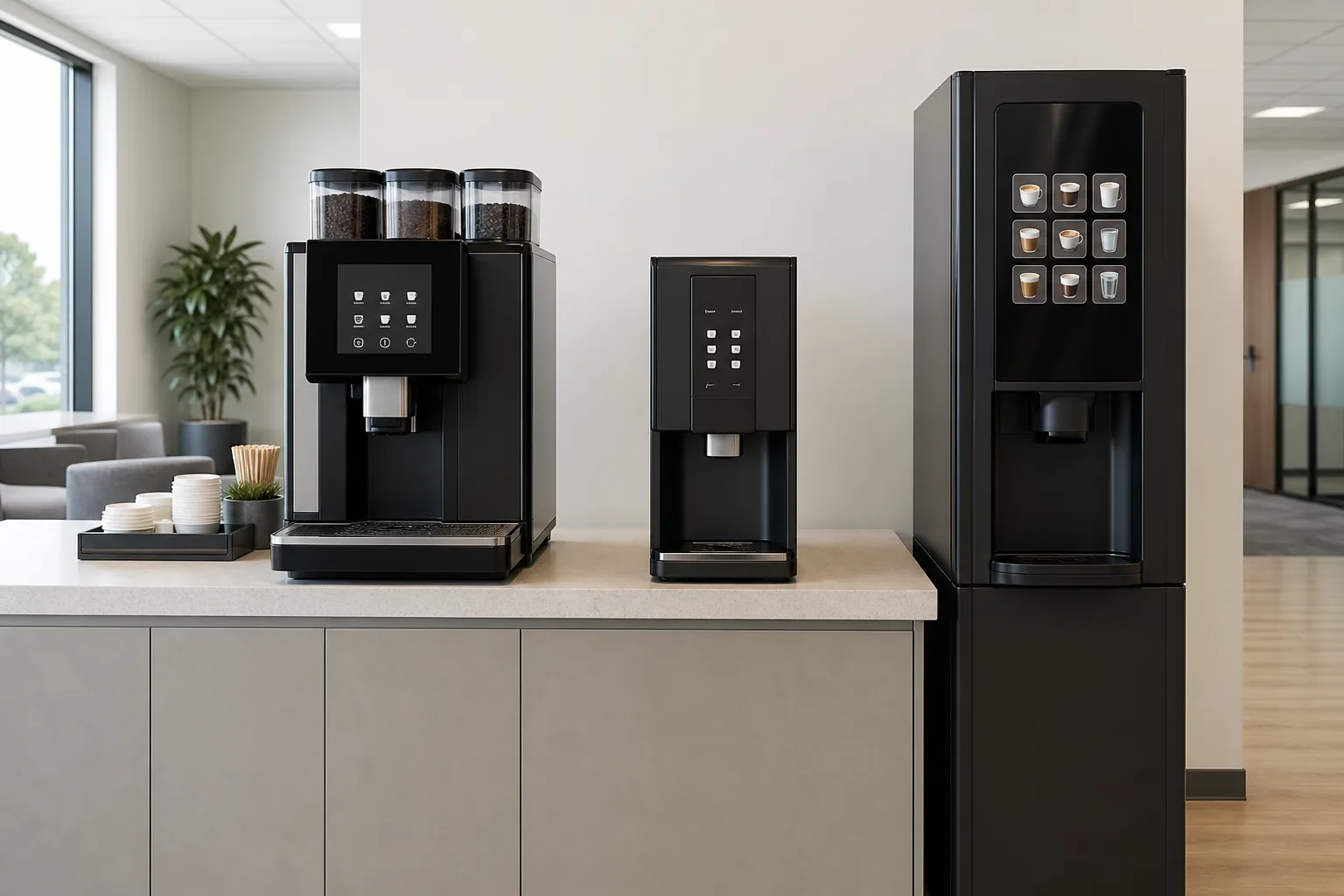
In short: Bean-to-cup grinds fresh for each drink and gives the best quality and the widest menu, but it needs a daily cleaning routine and someone to own it. Instant and granulated machines are quicker to run and far lower maintenance, trading some drink quality for reliability. Coffee vending is built for self-service in busy or unstaffed areas, with the capacity and payment options to match. In practice most sites choose by who will look after the machine, not by taste alone.
All three types produce a hot drink at the press of a button, and on a spec sheet they can look closer than they are. The real differences sit in three places: where the coffee comes from, how much attention the machine needs, and who it is designed to serve.
Bean-to-cup stores whole beans and grinds them per drink. Instant and granulated machines dose a pre-prepared product. Coffee vending is less a brewing method than a delivery format, it can be bean-to-cup inside, but it is built as a self-service unit with payment, capacity and a cabinet designed to stand in a corridor.
Get those three distinctions clear and the decision becomes much simpler than the brochures make it look.
This is the right default for most offices, client-facing areas and staff rooms where the coffee is part of how the workplace feels. Grinding per drink is what produces a cappuccino or flat white people would choose over the shop down the road.
The category scales further than any other, from machines rated at 80 cups a day up to the WMF 9000 S+ at 350, which carries up to four grinders and a 19g steel brewer. If you need the ratings band by band, they are set out in our guide to sizing office coffee demand.
Engineering quality shows in the brewing unit. The Rex-Royal S300, for instance, uses a 26g metal brewing unit with a 10.1-inch touchscreen and an outlet that detects the cup. Those details are what separate machines that hold up under heavy daily use from machines that merely survive it.
The trade is the routine. Milk systems need daily attention, the grinder and brewer need periodic care, and the machine will prompt for cleaning cycles that someone has to actually run.
Instant systems dose a pre-prepared coffee product rather than grinding beans. The drinks are not the equal of fresh-ground, and anyone who cares about coffee will tell you so, but that is not always the deciding factor.
What you gain is significant. There is no grinder to maintain, the cleaning burden is much lighter, speed per drink is faster, and the machine is far more tolerant of being ignored for a few days. Ingredient handling is simpler and the failure modes are fewer.
That makes it a solid answer for satellite offices, high-turnover environments, back-of-house areas and any site where nobody has been given clear ownership of the machine. A well-kept instant machine beats a neglected bean-to-cup every time.
The most common specification mistake we see is a premium bean-to-cup machine installed somewhere nobody is responsible for it. Six months later the drinks are poor and the machine gets blamed. Match the type to the ownership you actually have, not the ownership you hope for.
Coffee vending is designed for places where drinks are needed continuously and nobody is on hand to help, corridors, production floors, reception areas, gyms and any site running shifts through the night.
Capacity is the headline difference. Coffee vending units are touchscreen-operated, carry a wider hot-drinks menu than a countertop machine, and are sized to run for days between visits rather than hours. We confirm cup capacity for the model we recommend against your peak demand.
It also handles the commercial side that a countertop machine does not: payment, access control, and the option of free-vend or subsidised arrangements for staff. If drinks need to be available at three in the morning without anyone unlocking anything, this is the category.
Every type on this page automates a good deal of its own cleaning, and every type still needs a person to begin a cycle, empty a waste container and deal with milk. The difference between them is not whether that work exists, but how often it falls due and how forgiving the machine is when it gets skipped.
Bean-to-cup is the least forgiving, particularly with fresh milk, where a missed routine shows in the cup within days. Instant is the most tolerant of a quiet week. Coffee vending sits between the two, but at a scale where the visit tends to be scheduled rather than remembered. The routine itself is much the same in each case.
Before choosing a type, settle one question before you compare models: who does this, on which days, and what happens when they are on leave? That answer eliminates more options than any taste test.
Bean-to-cup wins in offices, client areas, meeting floors and anywhere the quality of the coffee reflects on you, provided the cleaning routine has a named owner.
Instant and granulated win in satellite sites, back-of-house areas, high-turnover environments and anywhere reliability matters more than refinement.
Coffee vending wins in corridors, production areas, shift environments, gyms and reception spaces, anywhere self-service, capacity and payment matter more than a barista-style menu.
Multi-floor and multi-building sites rarely have one answer. A common and sensible pattern is bean-to-cup on the client-facing floor, instant in the back office, and coffee vending on the production side or wherever the night shift works.
Mixing types is not a compromise, it is matching each location to how it is actually used. The only thing to keep consistent is the standard of maintenance, because a neglected machine of any type undoes the impression the good one creates.
A distribution business on one site: a 40-person head office, a 120-person warehouse, and a night shift running through to six in the morning.
Three locations, three different answers. The head office takes bean-to-cup, it is client-facing, someone there owns the routine, and the drink quality gets noticed. The warehouse mess room takes an instant system, because it is used hard, cleaned rarely, and has to tolerate being ignored over a weekend.
The warehouse floor itself takes coffee vending. A floor-standing unit sized for continuous self-service is what lets it serve a night shift with nobody attending it.
When future® Vending quotes a site like this, it is usually three specifications in one proposal rather than one machine repeated three times.
Tell us about your people, peaks and space. We will recommend a practical starting point and explain the trade-offs clearly.
Request a free proposalShort answers to the points that come up most often when you are choosing equipment.
Speak to our teamFor drink quality and menu range, yes. For maintenance, tolerance of neglect and simplicity, instant wins. The better choice depends on whether someone on site will own the daily cleaning routine.
Coffee vending is a delivery format rather than a brewing method, it can be bean-to-cup inside, but it is built for self-service with high cup capacity, payment options and a free-standing cabinet for corridors and unstaffed areas.
Instant and granulated systems. There is no grinder to maintain, cleaning is lighter, and the machine tolerates being left alone far better than a bean-to-cup machine will.
Yes, and multi-floor sites often should. Bean-to-cup on client-facing floors, instant in back-of-house and coffee vending for shift areas is a common and sensible combination.
Yes. Cashless and contactless payment can be specified, and machines can also be set up for subsidised or free-vend arrangements for staff.
Tell us what you are looking for and we will recommend the right coffee, water or vending setup for your site.
Estimate the annual cost of your current workplace coffee, hydration and vending setup and see where savings may be possible.
Estimate the cost of ending a current vending, coffee machine or refreshment agreement and review potential switch savings.