
Free calculator
Check now
Vending cost check
Estimate the annual cost of your current workplace coffee, hydration and vending setup and see where savings may be possible.
Two sites with the same headcount can need very different machines. The figure that matters is often not the one on the payroll report.
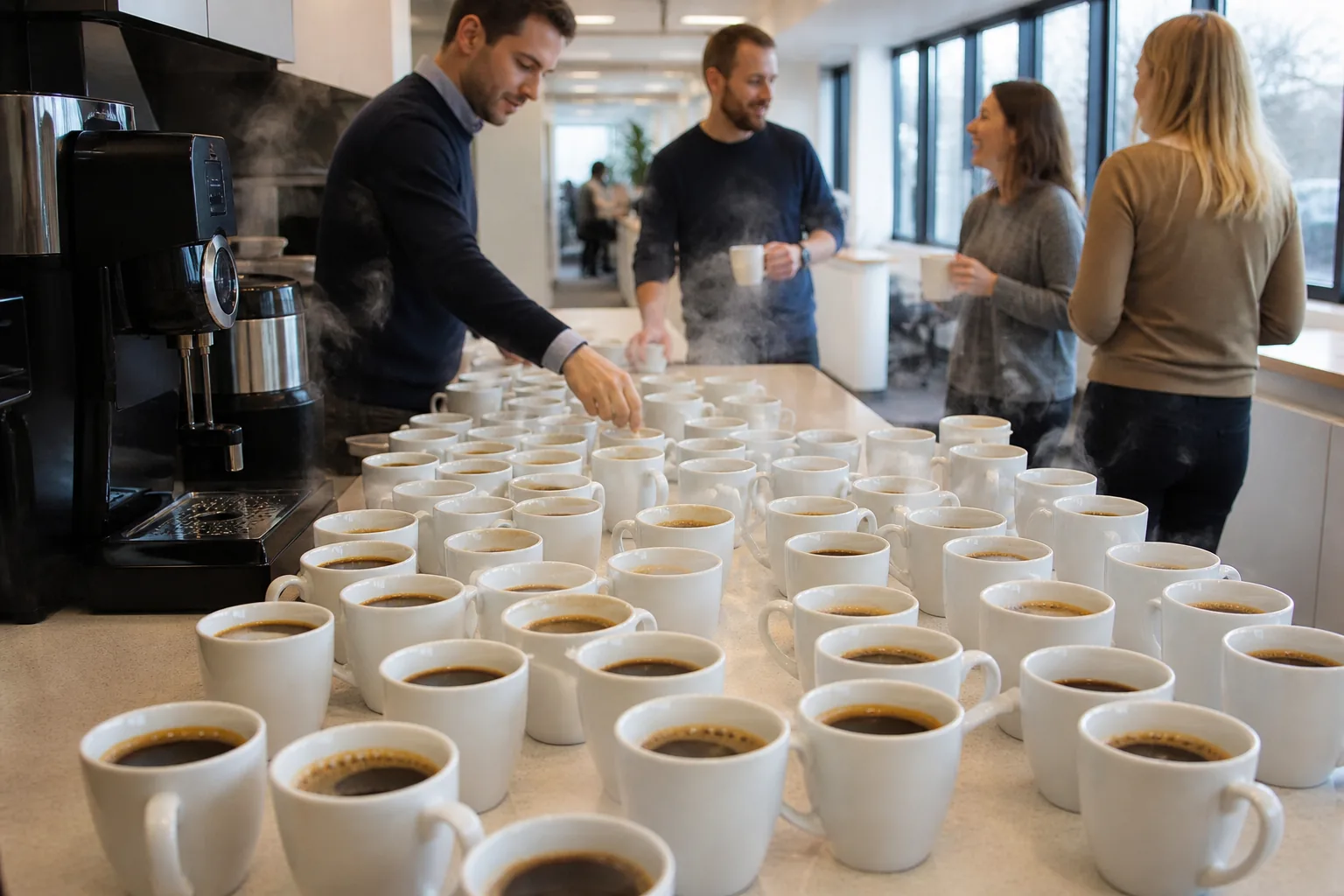
In short: Work out three numbers rather than one. Realistic daily attendance tells you who is actually in the building. Daily cups tells you which size band to look at. Peak fifteen-minute demand tells you whether one machine can cope. Most workplaces over-estimate their daily total and badly under-estimate their peak, which is why machines that look correctly specified still produce queues.
The number on the payroll is almost never the number in the building. Hybrid working, field-based staff, shift patterns and annual leave all sit between headcount and the people who will actually press a button on a Tuesday morning.
Use your busiest realistic day rather than your average one. If Tuesday and Wednesday bring 80 per cent of the team in and Friday brings 30 per cent, specify for Tuesday. A machine sized on the weekly average will be comfortable four days a week and embarrassing on the two that matter.
It is worth asking whoever manages the building for door-entry or desk-booking figures rather than estimating. The gap between what people think attendance is and what the data says is often twenty percentage points.
Not everyone on site drinks coffee, and the ones who do rarely stop at one. A workable starting assumption for a typical UK office is that somewhere between 60 and 75 per cent of people on site will use the machine, and that regular users average around two drinks across the day, one on arrival, one after lunch.
So a site with 120 people in on a busy day lands somewhere near 150 to 180 drinks. Then add the things people forget: visitors, interview days, client meetings, and the afternoon top-up that appears whenever a deadline does.
Treat that as a range, not a figure. The point is to establish which band you are in, because the bands are what machine specifications are built around.
If your site also has a boiling water tap, take the tea drinkers out of the coffee machine count. Tea and instant drinkers served by a tap can remove a surprising share of the load from an expensive bean-to-cup machine.
Manufacturers publish a daily output guide for every machine, generated under their own test conditions. They are not a guarantee, but they are the most reliable way to narrow a long list quickly.
Across our range the ladder runs roughly like this. Up to 50 cups a day suits the WMF 950 S. Around 60 suits the Bravilor Sego. At up to 80 you have the Franke A300 and the WMF 1100 S. Up to 100 brings in the Franke A400 and the JURA X4. Up to 120 covers the WMF 1300 S and the Bravilor Esprecious, and the JURA GIGA X3 is rated to 150.
Higher up, the Franke A600 and JURA GIGA X8c are rated to 200 cups daily. The WMF 5000 S+, Franke A800 and Franke SB1200 reach 250, the Franke A1000 handles 300, and the WMF 9000 S+ tops the range at 350.
Match your realistic daily figure to a band, then treat everything in that band as your list of options. The choice within a band comes down to menu, milk, cleaning and utilities rather than raw capacity.
Daily capacity is the number that gets quoted. Peak output in a rush is the number that determines whether people are happy.
Coffee demand in an office is not spread evenly, it arrives in two hard spikes. The first is the fifteen minutes after the main arrival window. The second is the twenty minutes after lunch. A machine can sit comfortably inside its daily rating and still be the source of a daily complaint because of what happens in those two windows.
Ask a different question at this stage: not how many drinks a day, but how many people want one at the same moment.
A milk-based drink takes roughly 40 seconds from pressing the button to walking away, once you include the few seconds people spend deciding and the moment they spend collecting. Black coffee is quicker, at around 25 to 30 seconds.
That puts a single outlet at somewhere between 20 and 22 milk drinks in a fifteen minute window, or a little over 30 black coffees. Compare that against the number of people arriving in your first spike and the answer is usually immediate.
A 200-person office with 60 people wanting a drink at 9am needs about three times the output a single standard outlet provides. No daily rating fixes that. It is a parallel capacity problem, and it has to be solved as one.
Where peak demand outruns a single machine, splitting is usually better than upgrading. Two machines in two locations halve the queue, shorten the walk, and mean a fault or a cleaning cycle never takes the whole building offline.
The alternative is a machine built for parallel output. The WMF 9000 S+ can produce coffee, hot water and steam simultaneously, which changes how many drinks it can make at once rather than just raising the daily ceiling.
There is also a scheduling answer. Sites with structured or staggered breaks, such as manufacturing, healthcare and contact centres, flatten their own peaks and can run comfortably on less equipment than an office of the same size.
A manufacturing site with 220 people on the payroll across three shifts, with staggered breaks inside each one.
Headcount alone would push you toward a machine rated at 350 cups a day. Attendance tells a different story. No more than 80 people are on site at any one time, and their breaks arrive in three waves of roughly 27 rather than in a single crush.
That makes the peak comfortably manageable on one outlet, and puts the realistic daily total near 180 across all three shifts. A WMF 1300 S sits in the right band, and the night shift is covered by the same machine rather than a second one.
Shift structure is the most common reason future® Vending recommends a smaller machine than a site expected, and it is the detail most often missing from an initial brief.
Specify a little above your current peak. Teams grow, attendance patterns shift back towards the office, and a machine running permanently at its ceiling wears faster and needs cleaning more often.
Over-specifying has its own costs, though. A larger machine takes more space, costs more to buy or rent, and generally asks more of whoever maintains it. One band of headroom is sensible. Three is money spent on capacity that will never be used.
Tell us about your people, peaks and space. We will recommend a practical starting point and explain the trade-offs clearly.
Request a free proposalShort answers to the points that come up most often when you are choosing equipment.
Speak to our teamA workable planning assumption is that 60 to 75 per cent of people on site use the machine, and regular drinkers average around two cups a day. For 120 people on site that lands near 150 to 180 drinks before visitors and meetings.
Peak demand is how many people want a drink in the same fifteen minutes, usually just after arrival and just after lunch. It decides whether a queue forms, and a machine can be well within its daily rating while still failing at peak.
A single outlet realistically serves 20 to 22 milk-based drinks or a little over 30 black coffees in fifteen minutes, once you allow for people choosing and collecting.
Two smaller machines in separate locations usually beat one large machine at peak, because they halve the queue and remove the single point of failure. One larger machine can win where space or budget is constrained.
About one band above your current peak. That absorbs growth and rising office attendance without paying for capacity you will not use or adding unnecessary maintenance.
Tell us what you are looking for and we will recommend the right coffee, water or vending setup for your site.
Estimate the annual cost of your current workplace coffee, hydration and vending setup and see where savings may be possible.
Estimate the cost of ending a current vending, coffee machine or refreshment agreement and review potential switch savings.