
Free calculator
Check now
Vending cost check
Estimate the annual cost of your current workplace coffee, hydration and vending setup and see where savings may be possible.
Most coffee machine mistakes happen when the machine is sized wrong, not when the brand is wrong. Here is the order we use with UK workplaces.
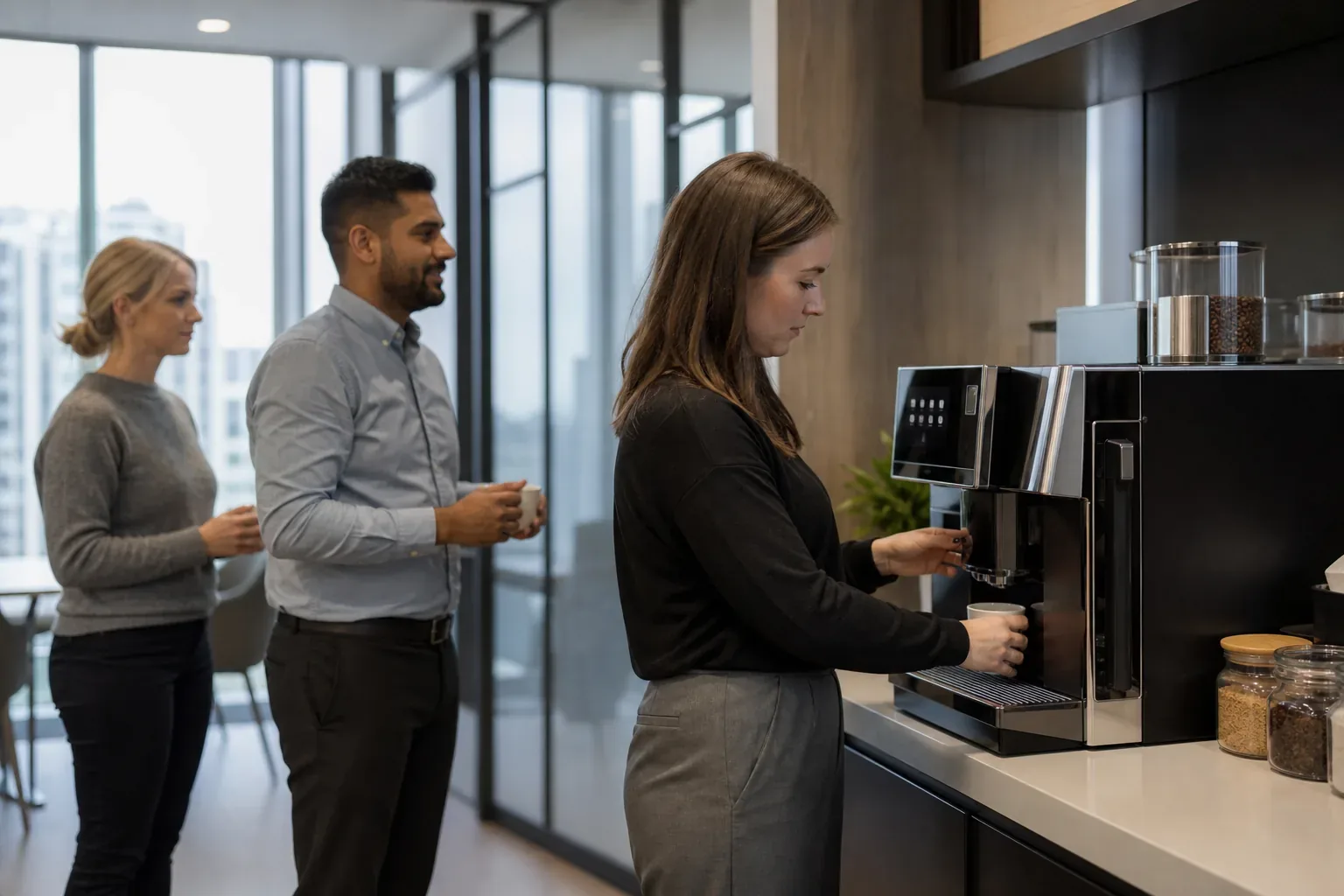
In short: Start with two numbers: how many drinks your site serves in a day, and how many people want one during the busiest fifteen minutes. Daily volume tells you which class of machine to look at. Peak demand tells you whether one machine is enough. Milk type, drink menu, cleaning routine and utilities then narrow the choices from there.
Every manufacturer publishes a daily output guide, and it is the single most useful number when you are narrowing a long list. These figures come from the manufacturers' own test conditions rather than your own site, so treat them as a band rather than a promise, but the bands are useful.
Our range of commercial coffee machines spans a wide ladder, from compact machines such as the Bravilor Sego at up to 60 cups a day, through the Franke A400 and JURA X4 at 100 and the WMF 1300 S at 120, up to the WMF 9000 S+ at 350. The full band-by-band breakdown sits in our guide to sizing office coffee demand.
To translate that into your own site, count people rather than cups at first. Coffee drinkers are a proportion of your headcount rather than all of it, and they average more than one drink across a day, which is why a realistic figure usually lands a band higher than the first guess.
Daily totals hide the moment that actually decides whether people are happy: the fifteen minutes after everyone arrives, and the twenty minutes after lunch. A machine can be comfortably within its daily rating and still produce a queue that puts people off using it.
The arithmetic is quick. A single outlet clears somewhere in the region of 20 to 22 milk-based drinks in a fifteen minute window, so an arrival spike much beyond that becomes a queue no daily rating will fix. We set out the full queue maths separately, but that one figure is enough when you are first choosing.
There are three usual answers. Split the demand across two smaller machines in different locations, which also removes the single point of failure. Move up to a machine with parallel output, the WMF 9000 S+, for example, can produce coffee, hot water and steam at the same time. Or accept the queue and stagger it, which works better in sites where break times are already structured.
A useful sanity check: count the people who arrive within the same fifteen minutes, not the people on the payroll. Sites with staggered shifts or hybrid attendance often need far less capacity in the rush than headcount suggests.
A 90-person professional services firm on a single floor, working hybrid, with around 60 people in on Tuesdays and Wednesdays.
Sixty on site, roughly 70 per cent of them coffee drinkers, at two drinks each puts the day near 85 cups. That points at the up-to-100 band, a Franke A400 or JURA X4, rather than the compact machine the quieter days would suggest.
The peak then settles it. About 25 of those people arrive inside the same fifteen minutes, which one outlet can clear with only a short queue. Fresh milk earns its daily routine here because the floor is client-facing, and a single machine is enough, though with little headroom, which is worth knowing before the team grows.
This shape of site is the most common enquiry future® Vending takes from offices, and the order above is how we work the numbers every time: attendance, then cups, then the peak.
Bean-to-cup grinds fresh for every drink and gives you the closest thing to a coffee shop menu. It rewards sites where people care about the coffee and someone will keep on top of a short daily routine, which covers most offices and any area that visitors see.
Instant and granulated systems trade some of that quality for speed and simplicity. There is no grinder to maintain and the cleaning burden is lighter, which suits high-turnover environments, satellite sites and places where nobody has been given ownership of the machine.
Coffee vending is the self-service answer for busy, unstaffed areas, corridors, production floors, reception areas and shift environments where drinks are needed around the clock and payment or access control may be part of the picture.
Milk drives more of the specification than most buyers expect, so settle it before you compare models rather than after. Fresh milk produces noticeably better cappuccinos and flat whites, but it brings a fridge, a daily cleaning cycle and someone who is responsible for both. Powdered topping removes nearly all of that and is often the better answer for unstaffed sites, but the drinks taste different and people notice.
Plant-based milk is now a standard question rather than a nice-to-have. Some machines handle it on a dedicated path. The Franke SB1200, for instance, can be configured with dairy or plant-milk routes, while others need a compromise. If a meaningful part of your team drinks oat or soya, raise it when you are choosing equipment, because retrofitting it is rarely straightforward.
Automatic cleaning has made this far less demanding than it used to be. The machine prompts, guides and largely runs the cycle itself, and our guide to cleaning and caring for a commercial coffee machine covers the daily and weekly detail.
What matters at specification stage is narrower: name the person who will do it. Whether that is an office manager, a cleaning contractor or a service visit, the decision belongs in your initial choice rather than after installation. If you cannot name that person, treat it as a reason to specify a lower-maintenance machine rather than a reason to hope.
Water supply is the first thing to establish. Some machines run from an internal tank, some need a permanent mains connection, and a few will do either. The WMF 1100 S can run from a 4.5 litre tank or continuous supply, the JURA X4 uses a 5 litre tank, and the JURA GIGA X8c expects a permanent water connection. Tank-fed machines suit sites where plumbing is difficult, but somebody has to refill them.
After that it is power, drainage, worktop depth, and whether there is clearance to open the machine for servicing. None of these are exciting, and all of them can invalidate your choices late in the day. It is why we check them on site before confirming a recommendation rather than after.
Buying outright is straightforward and usually the lowest total cost if the machine stays put for years and your headcount is stable. Rental keeps the commitment short and moves servicing into a single monthly figure, which suits growing teams and uncertain leases. Leasing spreads the cost of a higher-specification machine that would be hard to justify as a single capital item.
The honest answer depends on how confident you are about the next three years. If your headcount could change materially, flexibility is usually worth more than the lowest headline price. Our guide to buying, renting or leasing a workplace coffee machine works through the trade-offs in full.
Tell us about your people, peaks and space. We will recommend a practical starting point and explain the trade-offs clearly.
Request a free proposalShort answers to the points that come up most often when you are choosing equipment.
Speak to our teamCount the people actually on site on a busy day rather than the payroll, assume roughly 60 to 75 per cent of them use the machine and that regular drinkers have around two a day, then add an allowance for visitors and meetings. What matters is which capacity band that puts you in, not the exact number.
No. Bean-to-cup gives better drinks and a wider menu, but it needs a daily cleaning routine and someone to own it. For unstaffed sites, satellite offices or high-turnover environments, an instant or granulated system is often the more reliable choice.
Only if drink quality matters more than simplicity. Fresh milk gives better cappuccinos and flat whites but adds a fridge and a daily clean. Powdered topping removes most of the maintenance and suits machines nobody is directly responsible for.
It varies by model, but plan for worktop depth, clearance above for the hopper, access to open the machine for servicing and a route for water and waste. We confirm all of this on a site check before recommending a specific machine.
Buy if the machine will stay put for years and your headcount is stable. Rent if your team is growing or your lease is short. Lease if you want a higher-specification machine without the capital outlay. Your proposal compares all three routes.
Tell us what you are looking for and we will recommend the right coffee, water or vending setup for your site.
Estimate the annual cost of your current workplace coffee, hydration and vending setup and see where savings may be possible.
Estimate the cost of ending a current vending, coffee machine or refreshment agreement and review potential switch savings.