
Free calculator
Check now
Vending cost check
Estimate the annual cost of your current workplace coffee, hydration and vending setup and see where savings may be possible.
Choosing the machine is the easy part. Whether vending still works six months later depends on who restocks it and keeps it clean.
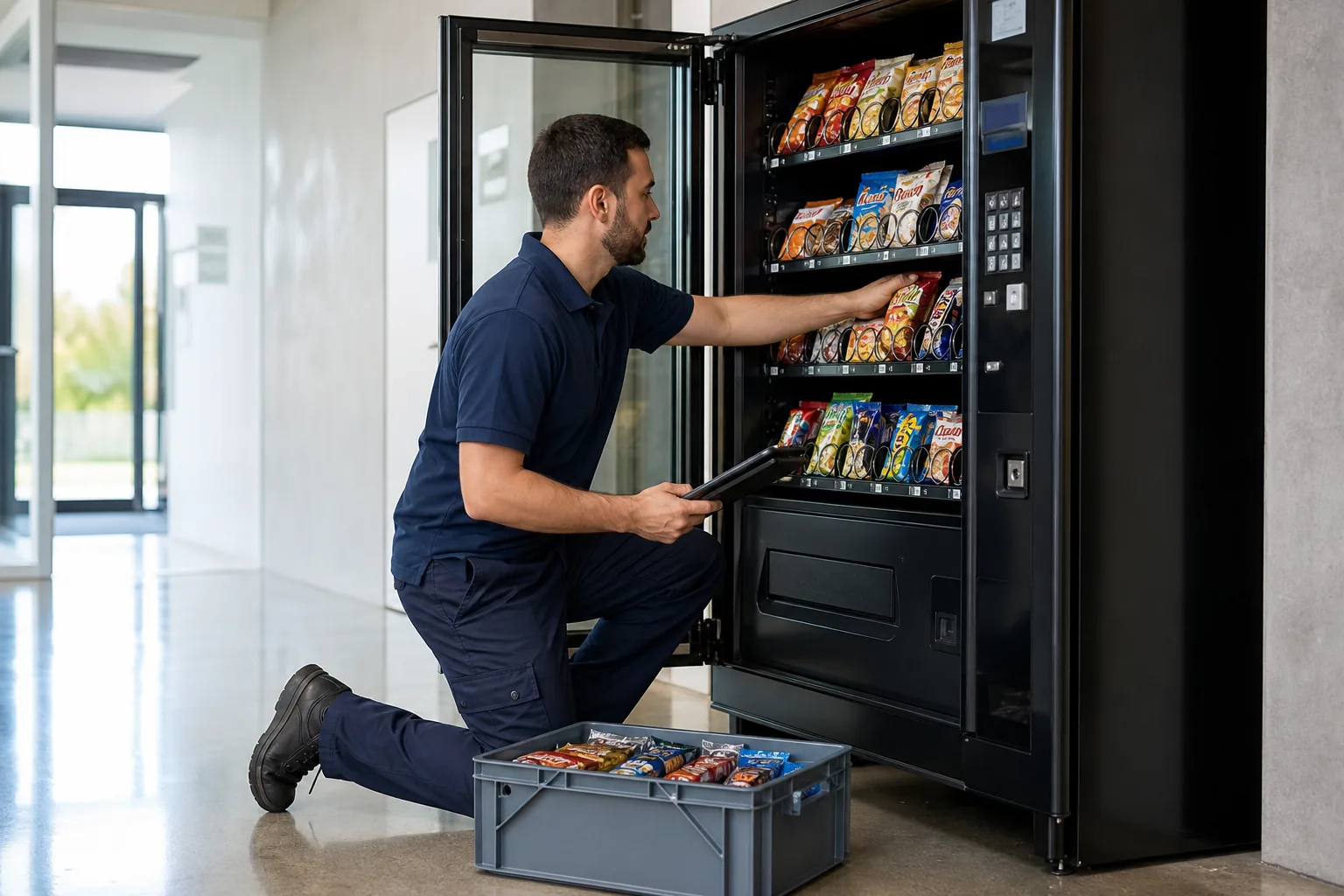
In short: Managed vending means we run the machine for you, not only deliver it. That includes choosing the range, restocking, cleaning, repairs and call-outs when something breaks. It pays off when no one on site can own restocking, when you sell fresh food with use-by dates and hygiene rules to follow, or when you have several sites that need to run the same way.
Managed vending is a service arrangement rather than a machine specification. The equipment may be identical to a self-managed installation; what changes is who is responsible for keeping it working and worth using.
In practice it covers product planning, deciding what goes in the machine and adjusting it as you learn what sells, along with replenishment visits, cleaning, routine maintenance and technical support when something fails.
The intent is that the machine stops being anyone's job on your side. Nobody counts stock, nobody places orders, nobody discovers on a Monday morning that the popular items ran out on Friday afternoon.
Self-managed vending gives you control, and for some sites that is the right trade. You choose the range, you set the prices, and you keep the margin.
What it asks in return is consistent attention. Someone has to monitor stock levels, buy product, physically fill the machine, keep it clean, handle the cash or card reconciliation, and notice when a selection stops selling. None of these tasks are difficult. All of them are recurring, and they tend to land on someone who already has a full role.
Self-managed works well where that person exists and the responsibility is explicit. It works badly where it is assumed.
Self-managed usually looks cheaper, because the labour is absorbed rather than invoiced. That is a real saving if the person doing it has genuine capacity, and an illusory one if it is being squeezed between other work.
Managed costs more visibly and less in aggregate than people expect, because it replaces a task that was consuming time nobody was measuring. It also removes the failure mode that quietly kills workplace vending, the machine that is half empty for a fortnight because the person who fills it was on leave.
The question is not which is cheaper on paper. It is whether the task will actually get done reliably, and what it costs you when it does not.
An empty machine is worse than no machine. Once people check twice and find nothing they want, they stop checking, and uptake rarely recovers even after restocking improves.
Four situations make the case straightforward.
Where nobody owns it. If you cannot name the person who will restock the machine and their backup, managed is the answer, because the alternative is a machine that degrades quietly.
Where you run fresh food. Date rotation, food safety responsibility and waste management are not tasks to hand casually to a facilities team.
Where you have multiple sites. Consistency across an estate is difficult to maintain when each site solves replenishment its own way, and it is exactly what a managed arrangement is built to deliver.
Where shifts run beyond office hours. Machines serving evening and night shifts get consumed on a different rhythm than anyone in a nine-to-five role will naturally track.
A motor dealer group with six sites, between 40 and 70 staff at each, and vending handled locally by whoever had time that week.
The machines were identical across the estate. The service was not. Two sites were regularly empty by Thursday, ranges had drifted so far apart that no two sites stocked the same core products, and nobody at group level had any view of what was selling or what it was costing them.
A managed arrangement fixed the estate rather than the equipment. One replenishment schedule, a consistent core range with room for local variation, and reporting that made the differences between sites visible for the first time.
Multi-site estates are the clearest case future® Vending sees for managed vending, because the problem is almost never the machine. It is six people solving the same task six different ways.
Smaller single sites with an engaged owner often do well self-managed, particularly where the range is narrow and predictable and the machine is snacks and cans rather than chilled food.
It also suits organisations that want tight control over range, a site committed to specific healthier options, particular suppliers or a subsidised staff price list may prefer to run it directly.
The honest test is whether the person responsible has the task written into their role rather than added to it informally. If it is a favour, it will lapse.
Chilled food raises the stakes considerably. Stock has to be rotated by date, unsold product has to be removed and disposed of, temperature has to be maintained and monitored, and food safety responsibility sits with whoever is managing it.
None of that disappears because the food is in a machine rather than on a counter. It is why fresh food vending is the category where sites most often move to a managed arrangement, even when they run their snack and drink machines themselves.
It is also the category where the decision is least reversible. Once chilled food is on site the obligations arrive whether or not the volume ever justified it, which is why the honest conversation about how many people will use the machine belongs before the machine is chosen rather than after.
If you are comparing managed arrangements, the details worth pressing on are practical ones.
How often replenishment visits happen, and whether that frequency adjusts as consumption patterns become clear. What the response time is when a machine fails, and what happens if a part is needed. Whether the product range gets reviewed against what is actually selling, rather than set once and left. And what visibility you get, a machine nobody reports on is a machine you cannot make decisions about.
A good managed service should be quietly improving the range over the first few months as the data comes in. If the planogram looks identical after six months, it is being restocked but not managed.
Tell us about your people, peaks and space. We will recommend a practical starting point and explain the trade-offs clearly.
Request a free proposalShort answers to the points that come up most often when you are choosing equipment.
Speak to our teamProduct planning, replenishment visits, cleaning, routine maintenance and technical support. The aim is that keeping the machine stocked and working stops being anyone's job on your side.
It costs more visibly, because the labour is invoiced rather than absorbed. Whether it is more expensive overall depends on whether someone on site actually has capacity to restock reliably, and what an empty machine costs you in uptake.
It is strongly advisable. Fresh food brings date rotation, temperature monitoring, food safety responsibility and waste management, which is why sites often move to a managed arrangement for chilled machines even when they self-manage snacks.
Visit frequency is set by consumption and adjusted as patterns become clear. A good arrangement reviews the range against what is actually selling rather than restocking a fixed list indefinitely.
Yes. A common pattern is self-managing snacks and cans while placing fresh food or remote-site machines under a managed arrangement.
Tell us what you are looking for and we will recommend the right coffee, water or vending setup for your site.
Estimate the annual cost of your current workplace coffee, hydration and vending setup and see where savings may be possible.
Estimate the cost of ending a current vending, coffee machine or refreshment agreement and review potential switch savings.